13 Systems Thinking Intervention Type Cards
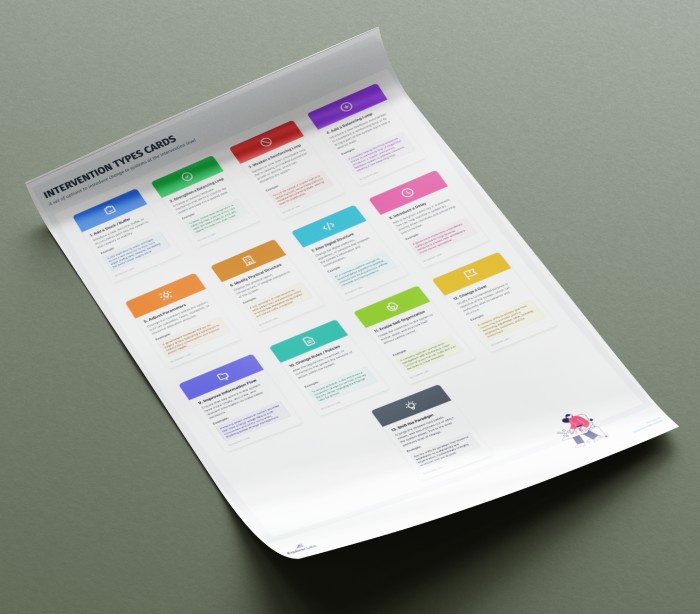
Read and review each of the card types.
Apply systemic operators to your key intervention designs
What does it do?
Provides a comprehensive framework for identifying where and how to intervene in a complex system to achieve a desired outcome. Rather than relying on a single approach, the tool offers 13 distinct types of interventions that range from simple numerical adjustments to profound structural and mental shifts.
- Identify Leverage Points: Determine whether to change simple rules or tackle deeper systemic goals and paradigms.
- Balance System Feedback: Learn how to strengthen balancing loops to stabilise a system or weaken reinforcing loops that cause unchecked growth or decline.
- Optimise Structure: Explore how modifying physical infrastructure or digital algorithms can shift behaviour patterns.
- Enhance Decision Making: Find ways to improve information flow and enable self-organisation within teams or communities.
Explorer Labs respects your privacy. We will only use your information to send your download and future updates on sustainable business innovation. You can manage your preferences at any time. Please see our Privacy Policy.

Also available on Miro for remote team collaboration
When to use it
This tool is essential for leaders, designers, and policymakers who are dealing with “wicked problems” where simple fixes have failed. Use it when:
- Problem Solving: You need to move beyond symptoms to address the root causes of systemic instability.
- Strategy Development: You are designing a new policy, product, or organizational structure and need to ensure it is resilient.
- Innovation Workshops: You want to brainstorm diverse ways to disrupt a stagnant system or scale a positive impact.
- Change Management: Your organisation is undergoing a major transition and needs to align its goals and values.
How to use it
STEP 1
Define the System: Clearly identify the system you are trying to change (e.g., a city’s traffic, a company’s culture, or a global supply chain).
STEP 2
Review the Options: Go through the 13 intervention types, starting from low-leverage points like Adjusting Parameters and moving toward high-leverage points like Shifting the Paradigm.
STEP 3
Analyze Current State: Identify which intervention types are currently being used and where they might be failing (e.g., are you only changing rules when you need to change the goal?).
STEP 4
Select New Interventions: Choose 2–3 new intervention types to explore. For each, use the provided example to brainstorm a specific application for your system.
STEP 5
Evaluate Impact: Consider how these interventions will interact. For instance, will Improving Information Flow help Enable Self-Organization?
Let’s Decode Your Complexity!
STRATEGIC INTERVENTIONS FOR SUSTAINABLE GROWTH
Ready to turn systemic challenges into design opportunities? Let’s schedule a brief session to align on your innovation goals and map out a path toward high-impact change