Innovation Initiative Blueprint Canvas
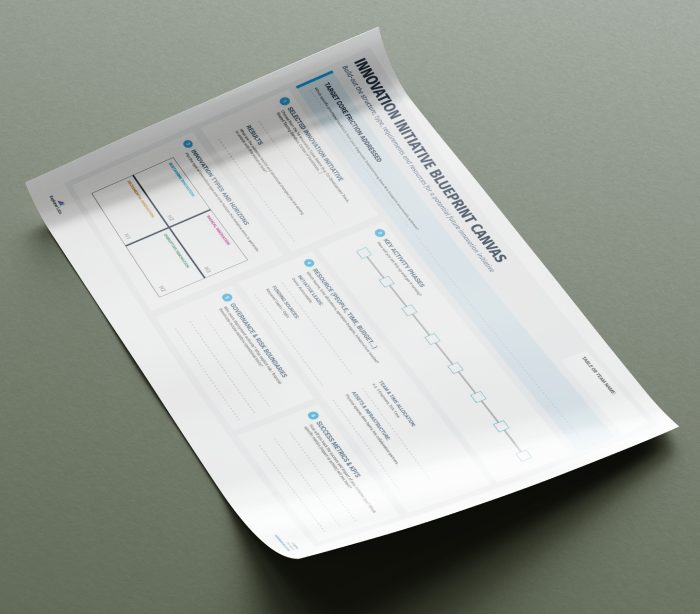
Your core challenge or friction to address
Your expected outcomes and results
Innovation types and horizons
Key activities to stand up the initiative
Planning people, owners and resources
Key governance and KPI’s
What does it do?
Helps you transition from abstract ideas and raw brainstorming results into a structurally defined, deployment-ready innovation initiative. By forcing teams to map out exact resource allocations, risk limits, and structural changes, it bridges the gap between identifying a systemic roadblock and launching a targeted intervention.
- Enables you to transform a prioritized friction point into a concrete innovation architecture.
- Helps you clarify the precise time horizons (H1, H2, H3) and innovation types (Sustaining, Radical, Disruptive) you are targeting.
- Establishes firm governance rules and success metrics before operational setup begins.
Explorer Labs respects your privacy. We will only use your information to send your download and future updates on sustainable business innovation. You can manage your preferences at any time. Please see our Privacy Policy.

Also available on Miro for remote team collaboration
When to use it
Use the Innovation Initiative Blueprint Canvas during the transition phase of your strategy sprint, right after you have diagnosed your systemic roadblocks and need to design targeted interventions.
You can also use this canvas when pitching a new pilot track, center of excellence, or shared testing sandbox to C-level stakeholders and leadership teams to secure structured alignment, funding, and operational authority.
How to use it
STEP 1
Identify the single, prioritized core friction point or roadblock from your diagnostic brainstorming sessions and place it at the top of the canvas.
STEP 2
Select your structural approach from the 16 Innovation Types Matrix (e.g., Co-development Track, Shared Testing Sandbox, Center of Excellence) and explicitly plot your target time horizon (H1, H2, or H3) across the incremental, sustaining, radical, or disruptive matrices.
STEP 3
Map out your key activity phases, detailing the step-by-step process of how you will structurally set up the initiative and get it actively running.
STEP 4
Detail your required resources, establishing precise team allocations (e.g., 3 Engineers, 25% Time), naming the accountable initiative leads, identifying CapEx/OpEx funding sources, and identifying necessary physical spaces or data layer infrastructure.
STEP 5
Define clear governance rules and risk boundaries, outlining exactly who holds deployment authority and setting explicit financial or operational thresholds that dictate sandbox limits.
STEP 6
Establish your success metrics and KPIs, balancing activity-based tracking with high-impact structural metrics to ensure clear visibility into the initiative’s long-term value.
Let’s Decode Your Complexity!
STRATEGIC INTERVENTIONS FOR SUSTAINABLE GROWTH
Ready to turn systemic challenges into design opportunities? Let’s schedule a brief session to align on your innovation goals and map out a path toward high-impact change