Systemic Experiment Design Card
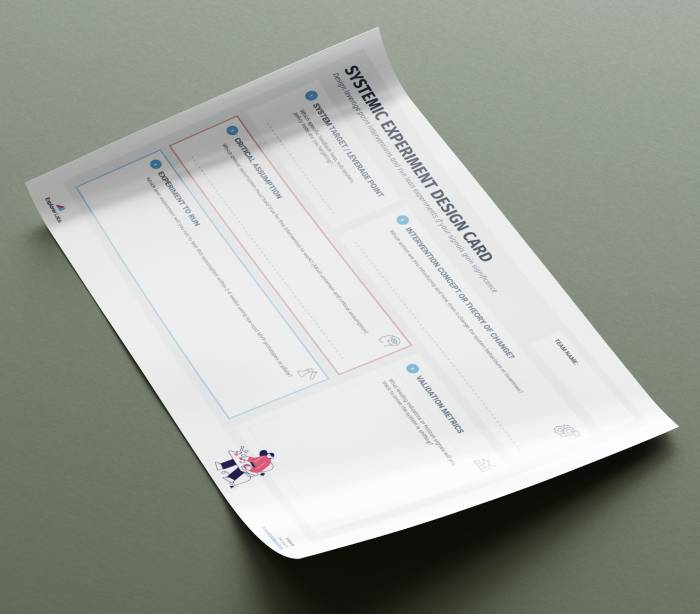
Systems map leverage point to target.
Systemic critical assumption being tested.
The specific systemic lean experiment you will run.
Key KPI metrics you will track if it is true, false or invalid.
What does it do?
Our Systemic Experiment Design Card is a strategic foresight and innovation tool designed to help teams plan leverage-point interventions and run lean validation experiments when weak signals start occurring.
- Targeting Systemic Leverage Points: Enables teams to isolate and focus on specific feedback loops, sub-systems, or policy nodes within a broader system.
- Exposing Critical Uncertainties: Empowers organizations to identify and test the most uncertain assumptions underpinning an intervention concept or theory of change.
- Measuring Systemic Shifts: Helps cross-functional groups define concrete low-cost MVP pilots and leading indicators to prove whether an intervention is actively shifting system behaviors.
Explorer Labs respects your privacy. We will only use your information to send your download and future updates on sustainable business innovation. You can manage your preferences at any time. Please see our Privacy Policy.

Also available on Miro for remote team collaboration
When to use it
By translating abstract systems maps and horizon scanning insights into practical, time-bound testing frameworks, this tool bridges high-level futures thinking with lean execution.
It prevents teams from running isolated product tests by forcing them to evaluate how a new action alters system behaviours, structural incentives, and feedback loops within a 2-to-4-week timeframe.
How to use it
STEP 1
Identify the System Target: Pinpoint the exact feedback loop, sub-system, or policy node your intervention is designed to impact.
STEP 2
Define the Intervention Concept: Outline your theory of change or action to specify how it alters system behaviours or incentives.
STEP 3
Isolate the Critical Assumption: Determine the single most uncertain and critical assumption that must hold true for the intervention to succeed.
STEP 4
Design the Lean Experiment: Plan a low-cost MVP prototype or pilot to test that core assumption within a 2-to-4-week window.
STEP 5
Set Validation Metrics: Establish the leading indicators or horizon signals you will track to verify that the system is shifting.
Let’s Decode Your Complexity!
STRATEGIC INTERVENTIONS FOR SUSTAINABLE GROWTH
Ready to turn systemic challenges into design opportunities? Let’s schedule a brief session to align on your innovation goals and map out a path toward high-impact change