Weak Signal Scenario Card
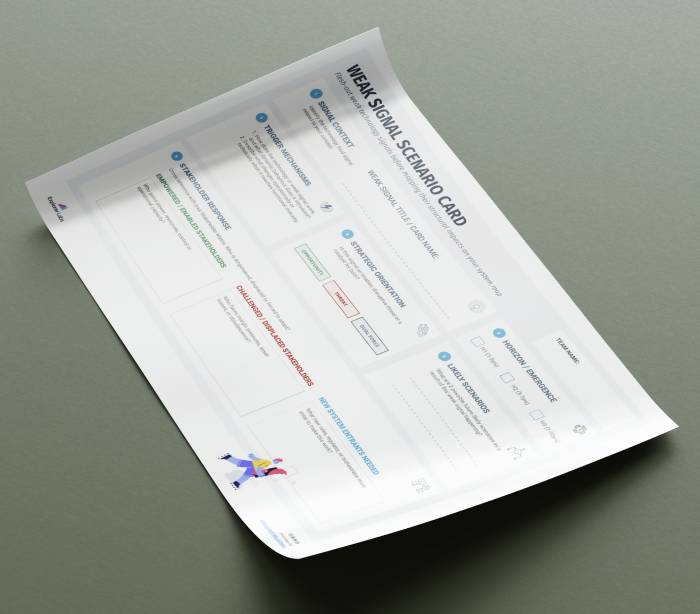
Context for the signal scenario being proposed
The likely systemic reactions that will occur at the variable and leverage point level.
Likely key stakeholder responses to the signal.
How soon it will likely emerge along with the outcome scenario.
What does it do?
Our Weak Signal Scenario Card is a strategic foresight tool used to flesh out and detail early-stage technology weak signals, mapping their horizon emergence, trigger mechanisms, and potential future scenarios before analysing their structural impacts on an organisation’s systems map
- Deconstructing Early Disruptions: Enables teams to analyze how a raw technology or weak signal works and what dynamic operational behaviors it introduces.
- Evaluating Strategic Orientation: Empowers leadership to classify whether an emerging signal acts as an enabler, a disruptive threat, or a dual catalyst force.
- Mapping Stakeholder Shifts: Helps cross-functional groups cross-reference changes with their stakeholder matrix to identify who becomes empowered, displaced, or forced to adapt.
Explorer Labs respects your privacy. We will only use your information to send your download and future updates on sustainable business innovation. You can manage your preferences at any time. Please see our Privacy Policy.

Also available on Miro for remote team collaboration
When to use it
By structuring vague or fringe technological anomalies into clear scenarios, this tool bridges the gap between raw horizon scanning and structural systems mapping.
It prevents organisations from dismissing early-stage trends by forcing teams to map out precise trigger mechanisms, horizon timeframes (H1, H2, H3), and stakeholder power realignments before the market shifts.
How to use it
STEP 1
Define Signal Context: Identify the technology or weak signal title and link it to your core concept or project focus.
STEP 2
Assess Horizon Emergence: Select the expected emergence timeline across H1 (1-3 years), H2 (3-7 years), or H3 (7-10 years).
STEP 3
Analyse Trigger Mechanisms: Describe how the technology works, what dynamic behaviours it introduces, and what changes operationally or technically when it reaches functional maturity.
STEP 4
Determine Strategic Orientation: Evaluate and check whether the signal acts as an opportunity, a threat, or a dual force.
STEP 5
Map Scenarios & Stakeholders: Outline two plausible future scenarios and cross-reference them against your stakeholder matrix to specify empowered groups, displaced players, and new system entrants needed.
Let’s Decode Your Complexity!
STRATEGIC INTERVENTIONS FOR SUSTAINABLE GROWTH
Ready to turn systemic challenges into design opportunities? Let’s schedule a brief session to align on your innovation goals and map out a path toward high-impact change