100 Ideation Cards for Critical Circular Materials
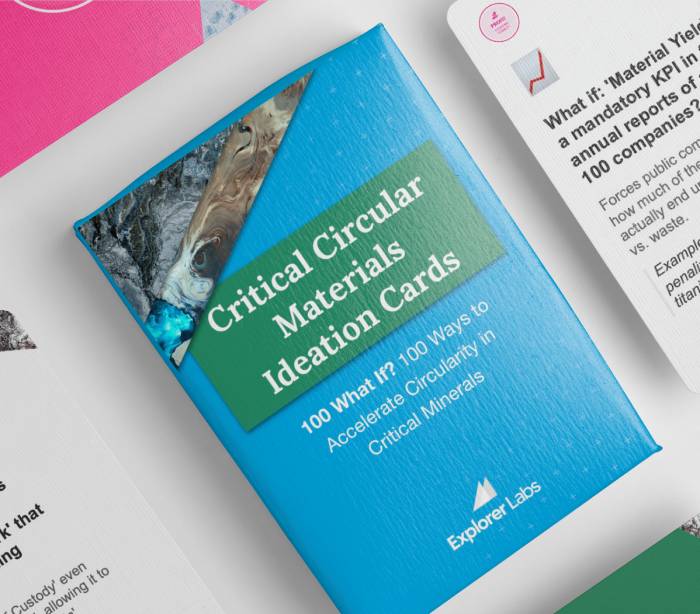
Choose a What If? Card from People, Planet, Profit or Progress
Ask your team the What If? question and read the example. Then ideate for 1 minute and move on to the next.
What do they do?
The transition to a circular economy for critical materials—such as Titanium, Lithium, and Cobalt—requires more than just better recycling. It requires a systemic overhaul of how we design, value, and recover materials. These 100 ideation cards are specifically engineered to help innovation teams, policymakers, and industrial leads break through “linear inertia” and the “drawer effect.”
-
PEOPLE (Social Desirability): Overcoming the “Drawer Effect,” data anxiety, and consumer friction in returning electronics.
-
PLANET (Environmental Necessity): Designing for material purity, avoiding contamination (especially in Titanium), and “Urban Mining.”
-
PROFIT (Economic Viability): New financial models, circular bounties, and de-risking supply chains against sovereign risk.
-
PROGRESS (Technological Feasibility): Scaling interventions like micro-refineries, digital material passports, and automated disassembly.
Explorer Labs respects your privacy. We will only use your information to send your download and future updates on sustainable business innovation. You can manage your preferences at any time. Please see our Privacy Policy.

Also available on Miro for remote team collaboration
When to use them
Early-Stage Ideation: Use these cards once you have formulated your “How Might We” (HMW) statements from your systems map.
Business Model Design: Use them when you need to challenge entrenched “Take-Make-Waste” mindsets during the design of new value propositions.
Policy & Strategy Workshops: Ideal for identifying high-leverage intervention points that require regulatory or collaborative shifts.
How to use them
STEP 1
Choose a category based on your systemic intervention goal. For example, choose People to tackle the “Drawer Effect” and consumer inertia, or Planet to address technical value leakage and material purity in Titanium and Lithium streams.
STEP 2
Read the provocative scenario aloud. These are designed to break “linear thinking” by presenting a radical shift in legal, technical, or market reality.
STEP 3
Each card explains the specific industrial or behavioural friction point it solves (e.g., overcoming data anxiety or reducing oxygen contamination in aerospace scrap) and provides a concrete example to ground the concept.
STEP 4
Brainstorm how your organization or partnership would operate if that scenario became a mandatory requirement. Use the card to trigger “Radical but Grounded” solutions that target the root causes identified in your Systems Map.
STEP 5
Determine the horizon for the idea. Is it a short-term “Circular Pilot” (H1), a medium-term “Value Chain shift” (H2), or a long-term “National Material Security” strategy for 2040 (H3)?
Let’s Decode Your Complexity!
STRATEGIC INTERVENTIONS FOR SUSTAINABLE GROWTH
Ready to turn systemic challenges into design opportunities? Let’s schedule a brief session to align on your innovation goals and map out a path toward high-impact change