Circular Intervention Blueprint Canvas
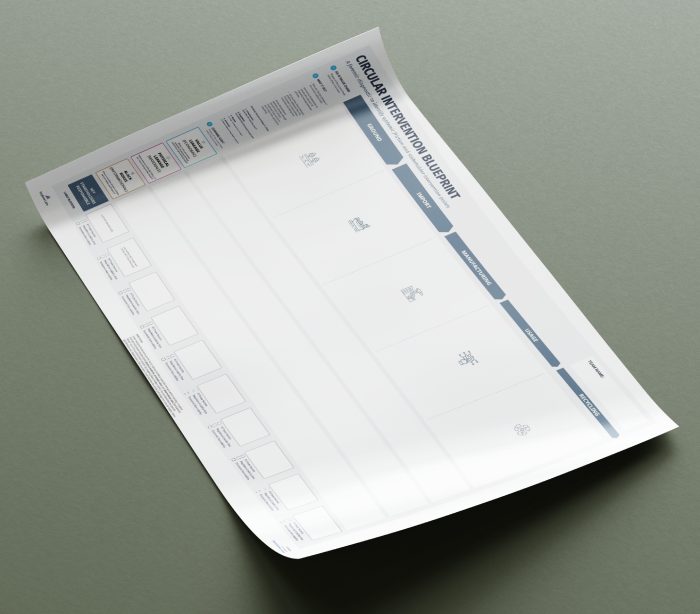
Map the As-Is Value Chain: Plot the current flow of your product or material through the five stages from Ground to Recycling
Audit Triple Leakage: Identify specific points where economic value, physical materials, or informational “black boxes” are lost or hidden
Identify Intervention Points: Determine which systemic friction points offer the highest potential for business design outcomes and innovation
What does it do?
A forensic diagnostic designed to identify systemic friction and stakeholder intervention points by auditing economic, material, and informational “leakages” across an as-is value chain—from ground and manufacturing to usage and recycling
- Maps “as-is” value chains from ground extraction through to recycling to visualise the complete material journey
- Audits systemic leakages across economic, physical, and informational “black box” dimensions to find hidden friction
- Identifies intervention points and responsible stakeholders to bypass blockers and drive circular outcomes
Explorer Labs respects your privacy. We will only use your information to send your download and future updates on sustainable business innovation. You can manage your preferences at any time. Please see our Privacy Policy.

Also available on Miro for remote team collaboration
When to use it
Use this forensic diagnostic when a team needs to move beyond high-level theory and visually map the “as-is” value chain to pinpoint exactly where material, economic, or informational value is being lost.
It is particularly effective during the strategy phase to identify systemic friction and specific stakeholder intervention points that are currently blocking circular outcomes.
Deploy this tool to uncover “black box” informational gaps and regulatory hurdles that prevent a business from transitioning from a linear model to a sustainable, closed-loop system.
How to use it
STEP 1
Map the As-Is Value Chain: Plot the current flow of your product or material through the five stages from Ground to Recycling.
STEP 2
Quantify Material Movement: Use arrow thickness to represent the volume of materials moving between each phase of the chain.
STEP 3
Audit Triple Leakage: Identify specific points where economic value, physical materials, or informational “black boxes” are lost or hidden.
STEP 4
Assign Stakeholder Responsibility: Pinpoint the specific internal or external owners accountable for the friction at each stage.
STEP 5
Evaluate Likely Blockers: Categorise the barriers to change as Intellectual Property/Trade Secrets, Regulatory/Liability risks, or Economic non-viability.
STEP 6
Identify Intervention Points: Determine which systemic friction points offer the highest potential for business design outcomes and innovation.
Let’s Decode Your Complexity!
STRATEGIC INTERVENTIONS FOR SUSTAINABLE GROWTH
Ready to turn systemic challenges into design opportunities? Let’s schedule a brief session to align on your innovation goals and map out a path toward high-impact change