
How a keynote at ESCP Berlin and a new Special Issue in the Journal of Business Venturing Design (JBVD) are bridging scholarly Design Science with high-impact corporate execution.
Bridge-Building Between Practice and Academia
A t the recent Tools in Entrepreneurship Symposium at ESCP Business School in Berlin, researchers and practitioners gathered to interrogate an overlooked reality in strategy and venturing: the artifacts we use shape the outcomes we achieve.
While tools like the Business Model Canvas, Lean Startup frameworks, and systems maps permeate corporate innovation labs, university incubators, and strategy rooms globally, they are too often treated as static “box-filling exercises” or informal craft.
Building on the Berlin symposium, the Journal of Business Venturing Design (JBVD) has officially launched a Special Issue Call for Papers: “Tools in Entrepreneurship: Moving from Craft towards Technology“ (edited by Erkko Autio, Hanna Buyssens, Llewellyn Thomas, and Christoph Seckler).
The goal? To complement trial-and-error entrepreneurial craft with a rigorous, scientifically grounded design science of tools.
At Explorer Labs, we operate at this intersection —co-developing, testing, and deploying over 100+ proprietary tools, canvases, and AI architectures with Fortune 500’s, governments, SME’s, leadership teams, global circular economy initiatives (such as the WEF Scale360° program) and research labs across Imperial Business School (Wicked Labs) and ESCP Berlin (DS:E Center for Design Science in Entrepreneurship).
Below is an overview of the core principles from our ESCP Berlin Keynote (“Tools Development in Entrepreneurship from Practitioner Perspectives“), detailing how we design tool architecture to solve complex systemic challenges—and how organisations can apply these frameworks to drive measurable strategy outcomes.

Part 1: Architecture of Tool Design
1. Addressing the Systemic Tooling Gap
Traditional customer-centric innovation frameworks (like early Design Thinking or basic Lean Startup loops) were built to optimise Problem-Solution Fit. However, when applied to modern corporate challenges—such as industrial decarbonisation, circular economy shifts, or non-linear AI disruption—these tools fall short. They optimise for localised human desirability and short-term viability while failing to account for complex systemic feedback loops, second-order consequences, and structural lock-ins.
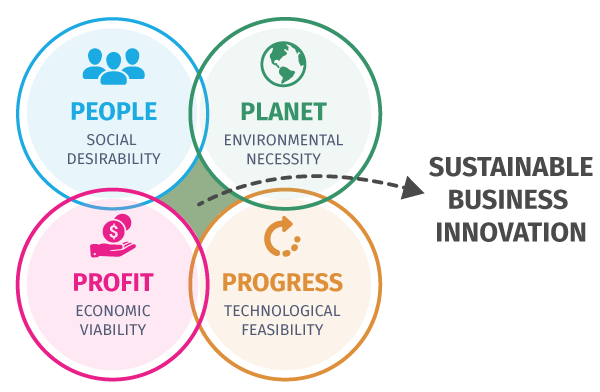
To bridge this gap, modern tool design must be grounded in The 4Ps Framework:
- People (Social Desirability): Equity, systemic human needs, and multi-stakeholder value.
- Planet (Environmental Necessity): Regeneration, circularity, and boundary conditions.
- Profit (Business Viability): Sustainable revenue models and network value exchange.
- Progress (Technological Feasibility): Frontier tech readiness, systems advancement, and signal detection.
2. Ideal Zone: Utility vs. Complexity
A core failure mode in tool development is the “Box-Filling Trap.” Overly complex tools (such as academic systems dynamics modelling software) alienate corporate teams, leading to abandonment. Conversely, overly simplistic tools yield trivial, low-impact insights.
The goal of effective tool architecture is to maximise utility while minimising cognitive friction, bringing users into the “Ideal Zone” where deep insights surface without cognitive fatigue setting in.

3. Tools as Knowledge Inputs and Outputs (“The Red Thread”)
Individual tools should never be created in isolation. They must function as a coherent knowledge chain where the output of Tools becomes the explicit input for the next Tool in the wider designed process:
When designing innovation programs or executive strategy sprints, we work backwards from the end strategic outcome, identifying knowledge gaps in the workflow and designing purpose-built artifacts to fill those exact friction points.

Part 2: Tools as Engagement & Value Drivers
Overcoming “First-Time Penalty”
When a team uses a strategic canvas or card deck for the first time, ~50% of their cognitive load is consumed just trying to understand how to use the tool.
To overcome this friction:
- Tailor with Concrete Workflows: Provide explicit, numbered step-by-step instructions and pre-populated domain examples.
- Optimise for Subsequent Usage: By the second or third run, cognitive load drops, allowing ~90% of mental energy to focus strictly on generating novel strategic insights.
- Drive Evidence-Based Decisions: Tools create a democratised, low-hierarchy workspace that forces teams to answer two critical questions: What do we know? and How do we know it?
Part 3: From Theory to High-Impact Application
Whether facilitating national circular economy interventions across 21+ countries or leading Innovate UK Ignite Labs on critical circular materials, the tool architecture remains the anchor for driving organisational capability:
By embedding these structured artifacts into your organisation, strategic foresight transforms from a static annual presentation into a repeatable, dynamic capability.

Advancing the Field: Partner with Explorer Labs
As research in the Journal of Business Venturing Design advances the theoretical foundation of entrepreneurial tools, Explorer Labs continues to pioneer their practical deployment in complex enterprise environments.
We partner with forward-thinking leadership teams, corporate strategy units, and public-sector innovation bodies to:
- Deploy In-House Horizon Scanning Radars: Combine proprietary card decks, A4 workshop canvases, and automated Perplexity AI prompt architectures to track weak signals 24/7.
- Design Custom Innovation Playbooks: Build bespoke toolkits, Miro workflow repositories, and intervention frameworks tailored to your industry’s specific systemic challenges.
- Facilitate Executive Strategy Labs: Deliver high-impact, in-person and hybrid strategy sessions designed to stress-test business models against 2030+ macro shifts.
Ready to Advance Your Innovation Capability?
- Explore Our Free Tool Repositories: Access open-access canvases and frameworks at explorerlabs.co/tools.
- Book a Brief Executive Alignment Call: Discuss your systemic innovation challenges or explore an in-house lab engagement by getting in touch below.

Let’s talk!
Reach out below
We’ll discuss your specific sustainable business-innovation challenges and what to do about them

Mike Pinder is a cross-industry business and innovation consultant, thought leader, author, senior trainer, lecturer and international keynote speaker. He’s driven by using innovation to leave the World a better place than we found it. Mike is a co-founder of Wicked Acceleration Labs (an industry-academia research lab aimed at tackling complex Systemic and Wicked Problems), Member of Board of Advisors at Global Innovation Institute (GInI), & Honorary Practice Fellow at Imperial College London Business School.
Mike consults and leads across Innovation Strategy, Systemic Design, Systems Thinking, Design Thinking, Lean Start-up and Entrepreneurship, Business Model Innovation in both B2B and B2C. He guides, trains and facilitates: C-Level Innovation Strategy, AI Enhanced Innovation Process and Methods, Tool Development and Design, Innovation Accelerators, Innovation Capability Training Programs, Academic Research, Executive Education (Exec Ed), University Program Design, Intrapreneurship, Digital Transformation, Design Sprints and more.